
The surveillance state isn’t coming. It’s being installed — on schedule, on budget, with your tax dollars, and with your consent manufactured one convenience at a time. The only thing still up for debate is whether you’ll recognize the cage before the door is programmable.
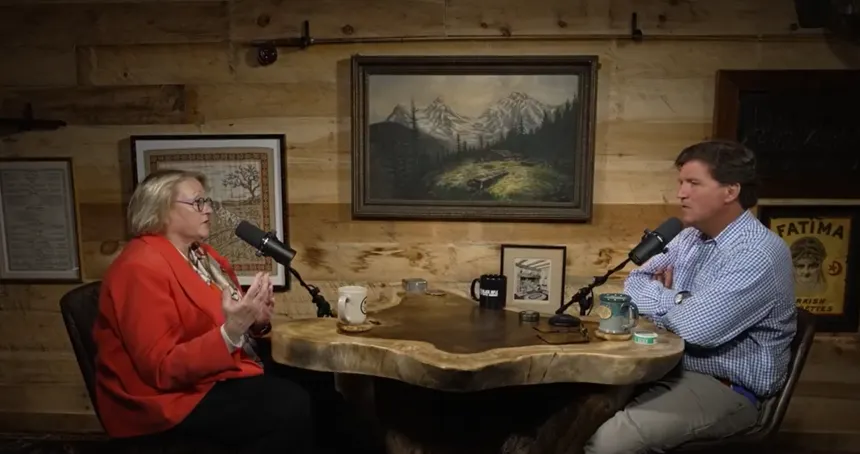
Source: Sense Receptor on X — Catherine Austin Fitts on the digital control grid
Former Assistant Secretary of Housing Catherine Austin Fitts lays out the architecture in three pieces: digital ID, programmable money, and the physical surveillance hardware that ties them to your body in space. In her telling, America already runs roughly 4,500 data centers, the license-plate and Flock-style cameras are already up — “we can see the Flock cameras” — and the whole apparatus, she argues, ultimately “depends on a digital ID.” Those are Fitts’s claims and Fitts’s framing, made on the record. Weigh them as the argument of a former federal official, not as our assertion of fact — and then notice how little of it is actually deniable.
“It Depends on a Digital ID” — Read That Twice
Strip the wonk vocabulary out of Fitts’s case and the load-bearing wall is one sentence: none of it works without a digital ID that ties your money and your movements to a single credential.
Translation: a system that can verify you can also decline you. An ID that unlocks your account is an ID that can lock it. That is not a bug they’re racing to fix. It is the feature the whole thing is built around.
This Isn’t Left or Right — Both Wings Are Pouring the Foundation
Do not let anyone file this under one party. The data-center buildout, the programmable-payment rails, the camera grid blanketing ordinary American towns — these advanced under both administrations, sold by Republicans as security and efficiency and by Democrats as access and inclusion. Same infrastructure, two marketing departments. The captured class doesn’t argue about whether to build the grid. It argues about whose brochure goes on the front.
Here’s How the Cage Actually Gets Built
The method is never a single law you can vote against. It’s accretion. First the camera goes up “for traffic safety.” Then the payment goes digital “for convenience.” Then the ID goes online “to stop fraud.” Each step is individually reasonable, locally funded, barely covered. Then one day the three systems quietly interoperate — the ID authenticates the money, the money is programmable, the cameras know where the body carrying it is — and the thing Fitts calls a control grid exists not because anyone announced it but because nobody was asked to approve it as a whole. The genius of it is that there’s no vote. There’s only the next reasonable upgrade.
The Only Honest Takeaway
You can argue with Fitts’s numbers. You cannot honestly argue the pieces aren’t being laid, because you can see the cameras from your own car. The real question her warning forces is the uncomfortable one: a system that can switch your money off when you misbehave is not a future risk to debate — it’s a present capability being assembled while you’re told to enjoy the convenience. Convenience is the anesthetic. The grid is the surgery.